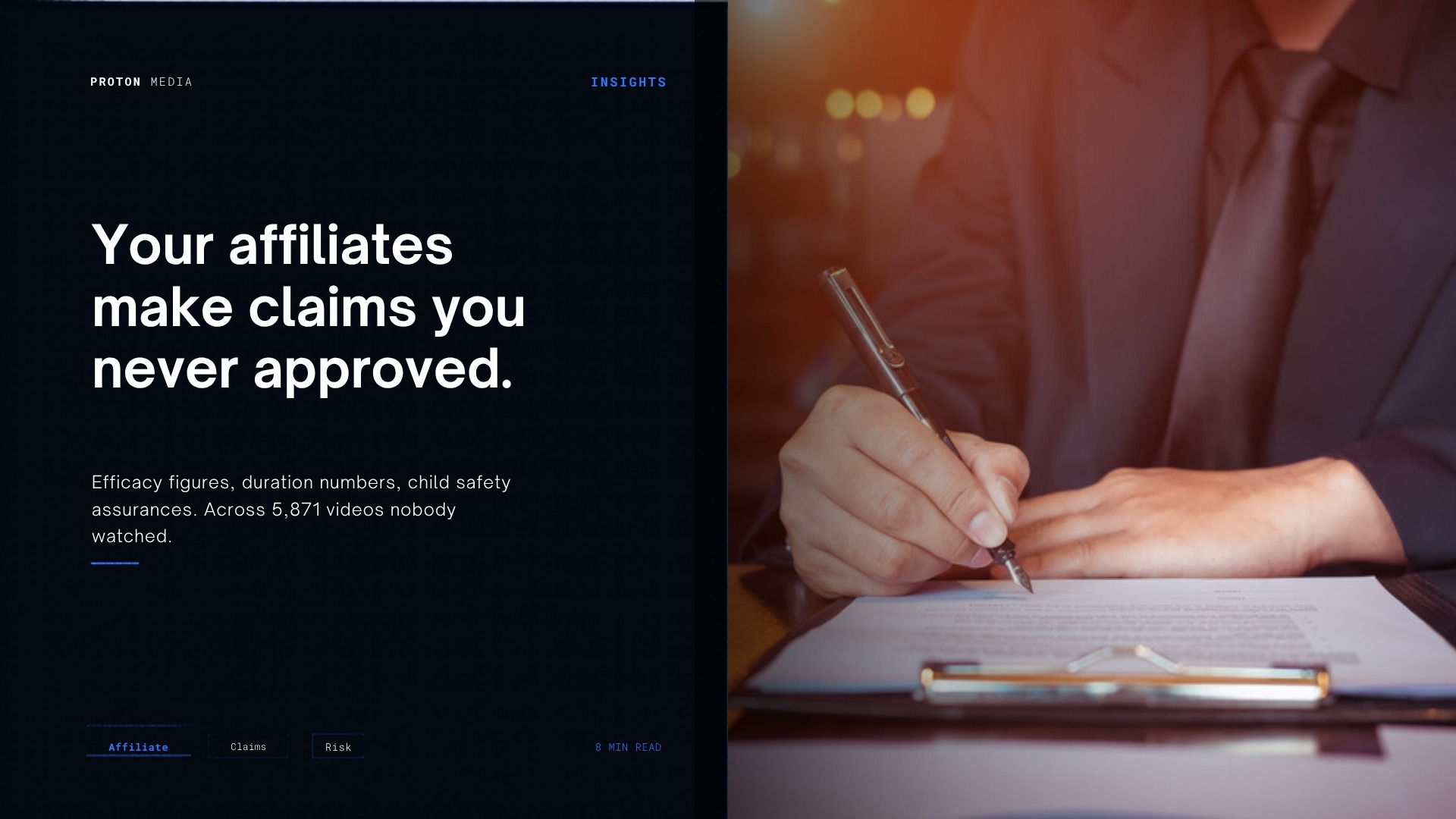
"Two times more effective at killing mosquitoes." "Lasts 45 nights." "Around Rp 300 per night." "Does not disturb your child's breathing."
Four claims from four different affiliate videos for the same product line. All four were spoken on camera by creators. None of them appeared in any brand-approved copy we could trace.
We found these while running frame-by-frame teardowns on affiliate videos from nine FMCG product lines in Indonesia. The dataset covered 5,871 videos. Nobody at the brand had watched more than a fraction of them.
That is the actual exposure. Not one bad video, but a claim surface that grows every time a new creator joins the program.
What the Claims Looked Like
The teardowns covered six videos from a single plug-in insect repellent line, three high performers and three that sold nothing. Between them they carried:
| Claim type | As spoken | What would verify it |
|---|---|---|
| Comparative efficacy | "2x lebih efektif bunuh nyamuk" | Registered efficacy data, stated comparator |
| Comparative efficacy | "2 kali lebih ampuh" | Same, with the baseline named |
| Duration | "45 hari" / "45 malam" | Packaging spec and usage assumption |
| Running cost | "Rp 300 per malam" | Wattage, tariff, hours-per-night calculation |
| Child safety | "tidak mengganggu pernapasan anak" | Product registration and approved safety wording |
| Emission | "tanpa asap, tanpa abu" | Product format, straightforward to confirm |
| Price | "Rp 20.000 satu paket" | Live listing at time of posting |
Some of these are almost certainly fine. A liquid vaporiser genuinely does not produce smoke or ash, and that claim survives scrutiny without any paperwork.
Others are not the same kind of statement. "Two times more effective" is a comparative efficacy claim with no stated comparator. "Does not disturb your child's breathing" reads as a safety assurance about a registered household insecticide. Both carry more weight than a creator can supply on their own.
Nothing Was Demonstrated
The more awkward finding: across all six videos, none showed the product working.
No dead mosquito. No collection tray. No overnight result. No before-and-after count. The visual proof in every case stopped at hands inserting a refill and plugging the device into a wall socket.
The claims were asserted in voiceover and the visuals showed installation. A viewer hearing "2x more effective" while watching a device get plugged in has been given a comparative efficacy claim and a setup demonstration, which are not the same thing.
This is not creators behaving badly. It is what happens when someone is asked to sell a product in 24 seconds and given no approved language to use.
The Scale Problem
A brand running 5,871 affiliate videos cannot review 5,871 affiliate videos. Nobody has that capacity, and the videos arrive faster than any review process can clear them.
Three properties make this harder than normal advertising compliance.
The content is spoken, not written. A claim inside a voiceover does not appear in any text field, caption, or asset library. Keyword monitoring on captions misses it entirely. Finding these claims required transcription.
The videos are ephemeral in practice. Creators delete, repost, and edit. A claim audited in March may not be the claim live in June under the same video ID.
Nobody owns it. Affiliate programs usually sit with commerce or growth teams. Claim approval sits with regulatory or legal. In most organisations these two functions have never met over an affiliate brief.
The Regulatory Backdrop
Indonesian consumer protection law, UU No. 8 Tahun 1999, addresses advertising that misrepresents a product's benefits, condition, or characteristics. It is the general framework consumer complaints run through.
Beyond that general law, product categories carry their own registration regimes. Household insecticides go through pesticide registration. Cosmetics and personal care go through BPOM. Registered products have approved claim language attached to that registration, and marketing communication is expected to stay inside it.
Platform rules add another layer. TikTok Shop's own commerce policies restrict health, safety, and comparative claims, and the enforcement mechanism there is takedown and account action rather than anything legal.
Where affiliate video sits inside all of this is genuinely unsettled. An independent creator making an unapproved claim about a registered product is a different fact pattern from the brand running the same claim in a TV spot. We are not going to pretend to resolve that here, and if your program carries volume in a registered category, this is a conversation for your regulatory counsel rather than your agency.
What we can say from the data is narrower and still useful: the claims exist, they are numerous, and no part of the current process is catching them.
Why This Is Hard to Just Fix
The obvious response is to ban unapproved claims and move on. The data complicates that.
The claims were doing conversion work. The top-earning video in the entire sample, at Rp 119 million, carried the child breathing comfort line, the 45-day duration claim, and a price assertion. The videos that stripped back to safe, generic language were disproportionately the ones that sold nothing.
That is not an argument for keeping unverified claims. It is a warning that claim discipline has a revenue cost, and a program that tightens language without replacing it will watch conversion fall and conclude that compliance broke the channel.
The replacement matters more than the restriction.
What to Put in Place
An approved claims list, written for speech. Not the regulatory dossier. A short sheet of sentences a creator can actually say out loud, with the verified duration, the verified format benefit, and the approved safety wording. If the only approved language is unusable on camera, creators will improvise, and improvisation is where the exposure comes from.
A negative list with examples. Naming what cannot be said is more effective than describing categories. "Do not claim the product is more effective than any other product" is clearer than "avoid comparative claims." Include the specific phrases already circulating in your program, because those are the ones that spread.
Transcription-based spot audit. Pull a sample each month, transcribe the audio, and read what was actually said. Caption review is not sufficient because these claims live in voiceover. A sample of thirty videos will surface the recurring phrases quickly, and recurring phrases are the ones worth fixing.
Claim terms in the creator agreement. Most affiliate agreements cover disclosure, exclusivity, and commission. Fewer cover what may be said about the product. Adding it costs nothing at signup and is close to impossible to retrofit.
Efficacy proof the video can actually show. If the product genuinely demonstrates something, get that demonstration into the brief. The teardown found that none of these videos showed the product working, which means the strongest available proof was never used. Some of the claim pressure comes from having nothing to show.
The Part Worth Sitting With
A brand with three hundred affiliates has three hundred people describing its products in their own words, on camera, to audiences the brand cannot see, using claims it never wrote.
That is not a hypothetical risk. It is the operating model.
For how briefing decisions shape what creators end up saying, see the case for briefing over recruiting. For the video mechanics behind the numbers in this dataset, see the analysis of 5,871 FMCG affiliate videos.